Website Designing Traning in Islamabad City

Website Designing Training in Islamabad City is designed for beginners and professionals who want to build strong, practical skills in modern web design. This training focuses on real-world techniques, including HTML, CSS, responsive layouts, and user-friendly design principles. Students learn how to create visually appealing and functional websites that work smoothly on mobile, tablet, and desktop devices. The course structure is simple and step-by-step, making it easy for learners to understand concepts and apply them confidently.

The training also emphasizes hands-on practice, project-based learning, and industry-relevant tools used by professional designers. Participants get the opportunity to work on live projects, improve their creative thinking, and understand client requirements. With experienced trainers and a supportive learning environment, this website designing training in Islamabad helps students prepare for freelance work, job opportunities, or starting their own digital services with confidence and professionalism.

Website Designing Course

  • Introduction to Web Design & Internet Basics
  • HTML5 Structure and Page Layout
  • CSS3 Styling, Colors, Fonts, and Layouts
  • Responsive Web Design (Mobile, Tablet, Desktop)
  • Basic JavaScript for Interactivity
  • UI/UX Design Principles
  • Using Design Tools (Figma / Photoshop basics)
  • Website Optimization & Performance Basics
  • Final Project and Portfolio Development

0332-5649993


Are you looking to enhance your web design skills? Website designing training in Islamabad offers a valuable opportunity. With the digital landscape evolving, having a strong online presence is essential. This blog post will explore the best training programs available in Islamabad. We will discuss the skills you can learn and how they can boost your career. Let’s dive into the world of website design and discover your potential!

Read More

Import and Export Course in Rawalpindi 6th road

An Import and Export Course in Rawalpindi is ideal for individuals who want to enter international trade or expand their existing business knowledge. This course provides a clear understanding of global trade procedures, documentation, and compliance requirements. Students learn the fundamentals of customs clearance, shipping methods, incoterms, and payment systems used in cross-border transactions.

The training emphasizes practical skills needed to manage real import and export operations. Participants are guided through product sourcing, supplier negotiation, cost calculation, and risk management. Experienced instructors share industry insights and case studies, helping learners understand market trends and avoid common trade mistakes. The course structure is suitable for beginners, entrepreneurs, and professionals looking to strengthen their trade expertise.

Completing an import and export course in Rawalpindi opens doors to career opportunities in trading firms, logistics companies, and manufacturing businesses. Graduates can also start their own import-export ventures or support local companies in reaching international markets. With global trade continuously growing, this course offers valuable skills for long-term professional success.

Read More

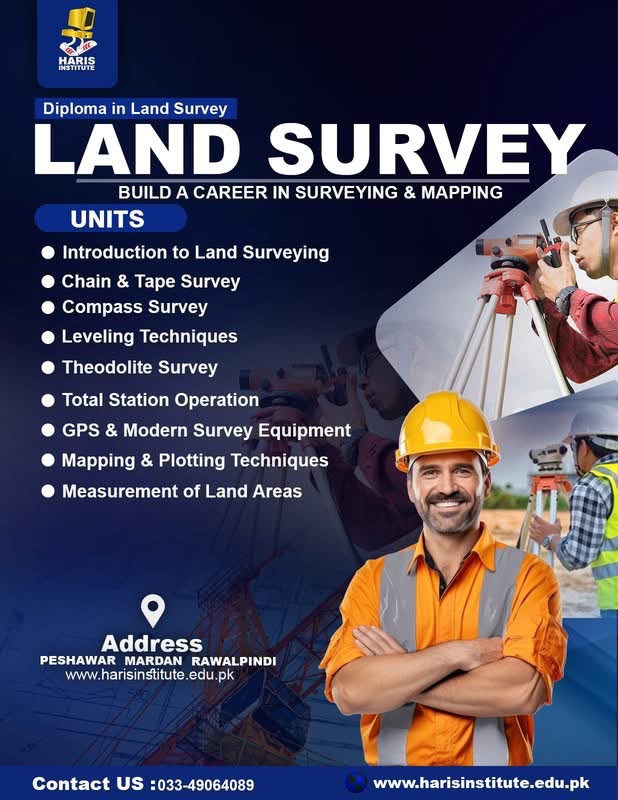
Civil Surveyor Course in Rawalpindi | Total Station

A **Civil Surveyor Course in Rawalpindi | Total Station* is an excellent opportunity for individuals who want to build a practical and in-demand skill in the construction and real estate sectors. This course is designed to provide hands-on training in modern surveying techniques, including the use of total stations, GPS equipment, and leveling instruments. Students gain a clear understanding of land measurement, boundary marking, and site layout, which are essential for roads, housing projects, and commercial developments.

0334-0950505

The training focuses on both theoretical knowledge and field practice to ensure learners can confidently handle real-world projects. Participants learn map reading, site calculations, contouring, and basic drawing for survey reports. Experienced instructors guide students through actual fieldwork, helping them understand professional standards and safety practices commonly followed in the industry. This practical approach makes the course suitable for beginners as well as professionals seeking skill enhancement.

Completing a land survey course in Rawalpindi opens doors to multiple career paths, including work with construction companies, engineering firms, and government departments. Graduates can also offer freelance surveying services or support large infrastructure projects across Pakistan. With continuous development in urban and rural construction, trained land surveyors remain in high demand, making this course a smart choice for long-term career growth. Land Survey Course in Rawalpindi 6th Road Civil Surveyor Course in Rawalpindi | Total Station

Civil Surveyor Course Content:

  • Introduction Civil Surveyor
  • Classification of survey
  • .Principles of survey
  • Chain survey
  • Plotting of chain survey
  • Compass survey
  • Bearing system
  • Drawing Scales
  • Types of scales
  • Leveling
  • Technical terms
  • Purpose of Leveling
  • Plain table survey
  • Methods of plane table survey
  • Adjustment of Levels

land servey course

Civil Surveyor Course in Rawalpindi | Total Station

  1. What is a Civil Surveyor Course in Rawalpindi?
    It is a practical course that teaches land surveying, construction surveying, measurements, leveling, and the use of modern surveying instruments.
  2. What is Total Station?
    Total Station is an electronic surveying instrument used to measure angles, distances, coordinates, and elevations.
  3. Is Total Station included in the Civil Surveyor Course?
    Yes, practical Total Station training can be an important part of the course.
  4. Who can join a Civil Surveyor Course?
    Students, beginners, civil engineering learners, draftsmen, construction workers, and job seekers can join.
  5. Is previous surveying experience required?
    No. Beginners can start with basic surveying concepts.
  6. What will I learn about Total Station?
    You can learn instrument setup, station setup, backsight, coordinate entry, measurements, data collection, and basic setting-out work.
  7. What is land surveying?
    Land surveying is the process of measuring and determining the location, distance, direction, and elevation of points on land.
  8. What is construction surveying?
    Construction surveying helps transfer building, road, foundation, and other project measurements from drawings to the actual site.
  9. What is leveling in surveying?
    Leveling is used to determine differences in elevation between points.
  10. What is a benchmark?
    A benchmark is a known reference point with an established elevation.
  11. What is a survey station?
    A survey station is a selected point from which measurements are taken or used as a reference.
  12. What is a backsight?
    A backsight is a measurement taken to a known reference point to establish the orientation of a survey instrument.
  13. What is foresight?
    A foresight is generally a measurement taken toward a point whose elevation or position needs to be determined.
  14. What is a traverse survey?
    A traverse survey determines the positions of points through a series of connected survey lines.
  15. What is an open traverse?
    An open traverse starts and ends at different points and is commonly used for routes such as roads and pipelines.
  16. What is a closed traverse?
    A closed traverse forms a closed shape or returns to a known point, allowing checks on survey measurements.
  17. What is an Auto Level?
    An Auto Level is a surveying instrument mainly used for determining differences in elevation.
  18. What is a measuring tape used for in surveying?
    It is used for measuring shorter distances and checking dimensions.
  19. What is a prism in Total Station surveying?
    A prism reflects the instrument’s signal and helps the Total Station measure distance to a survey point.
  20. Can Total Station work without a prism?
    Many modern Total Stations have reflectorless measurement capabilities, depending on the instrument model.
  21. What is a prism pole?
    A prism pole holds the survey prism at a controlled height above a point.
  22. What is instrument centering?
    Centering means positioning the surveying instrument directly above the survey point.
  23. What is leveling of a Total Station?
    It means adjusting the instrument so that its vertical axis is properly aligned and the instrument is level.
  24. What is coordinate surveying?
    Coordinate surveying determines the position of points using coordinate values such as northing, easting, and elevation.
  25. What are Northing and Easting?
    They are coordinate values used to describe the horizontal position of a point in a coordinate system.
  26. What is elevation?
    Elevation is the vertical position of a point relative to a selected reference level.
  27. What is reduced level (RL)?
    RL is the elevation of a point relative to an established datum or reference level.
  28. What is datum in surveying?
    A datum is a reference surface or system used for measuring elevations or coordinates.
  29. What is setting out?
    Setting out transfers positions, dimensions, and levels from construction drawings to the actual site.
  30. Can a surveyor set out building foundations?
    Yes, surveyors commonly assist in transferring foundation locations and reference points to the site.
  31. What is building layout surveying?
    It involves marking building corners, grid lines, foundation positions, and other design points on the ground.
  32. What is road surveying?
    Road surveying involves measuring and establishing alignments, levels, profiles, and other information needed for road construction.
  33. What is an alignment?
    Alignment defines the planned horizontal or vertical path of a road, pipeline, or other project.
  34. What is a centerline?
    A centerline is a reference line used to define the central alignment of a construction or infrastructure project.
  35. What is a cross-section survey?
    It records ground levels across a line perpendicular to a project alignment, commonly used in roadwork.
  36. What is a longitudinal profile?
    It shows changes in ground elevation along a selected alignment.
  37. What is contour surveying?
    It involves collecting elevation data to represent the shape and relief of the land.
  38. What are contour lines?
    Contour lines connect points having the same elevation on a map or survey plan.
  39. What is a topographic survey?
    A topographic survey records natural and man-made features along with ground elevations.
  40. What is a site survey?
    A site survey collects measurements and information about an area before or during construction.
  41. Can beginners learn Total Station?
    Yes. With proper practical training, beginners can learn the basic operation and surveying workflow.
  42. Is practical training important for a surveyor?
    Yes. Field practice helps learners understand instrument setup, measurements, calculations, and site procedures.
  43. Will the course include field practice?
    A practical Civil Surveyor program may include field exercises using surveying instruments and construction examples.
  44. What surveying instruments are commonly taught?
    Depending on the course, learners may work with Total Station, Auto Level, measuring tape, prism, prism pole, and other basic equipment.
  45. What is GPS/GNSS surveying?
    GPS/GNSS surveying uses satellite positioning systems to determine the coordinates of survey points.
  46. Is GPS included with Total Station training?
    It depends on the institute and course syllabus. Some programs include basic GPS/GNSS surveying.
  47. Can surveyors use AutoCAD?
    Yes. AutoCAD is commonly used for preparing, editing, and presenting survey drawings.
  48. Is AutoCAD necessary for a civil surveyor?
    Basic AutoCAD knowledge can be useful for working with survey plans and construction drawings.
  49. What is a survey drawing?
    A survey drawing presents collected field information, coordinates, levels, boundaries, and other relevant site details.
  50. What is a field book?
    A field book is used to record survey observations, measurements, sketches, and site information.
  51. What is a survey report?
    A survey report documents the survey work, measurements, findings, and relevant project information.
  52. What is an offset in surveying?
    An offset is a measured distance from a survey line to locate a feature or point.
  53. What is chain surveying?
    Chain surveying is a basic surveying method in which linear measurements are the primary observations.
  54. What is plane table surveying?
    It is a graphical surveying method in which field observations and drawing are carried out together.
  55. What is an angle in surveying?
    An angle represents the direction relationship between two survey lines and can be measured with instruments such as a Total Station.
  56. What is horizontal distance?
    Horizontal distance is the distance between two points measured or reduced along a horizontal plane.
  57. What is slope distance?
    Slope distance is the direct distance between two points along a sloping line.
  58. What is an EDM?
    EDM stands for Electronic Distance Measurement. It uses electronic technology to measure distances.
  59. Does a Total Station use EDM?
    Yes. A Total Station combines electronic distance measurement with angle measurement and data processing.
  60. What is data collection in surveying?
    It is the process of recording coordinates, measurements, codes, and other field observations for later processing.
  61. What is a survey data collector?
    It is an electronic device or integrated controller used to enter, store, and manage field survey data.
  62. What is resection in Total Station surveying?
    Resection is a method used to determine the instrument position by observing known survey points.
  63. What is stakeout in Total Station?
    Stakeout, or setting out, guides the surveyor to the location of designed points on the ground.
  64. Can Total Station be used for road projects?
    Yes. It can be used for various road surveying and setting-out tasks.
Read More

News Anchor Course in Rawalpindi-islamabad

Our News Anchor Course in Rawalpindi–Islamabad is designed for individuals who aspire to build a confident and professional career in electronic media. This course focuses on voice modulation, script reading, on-camera presentation, body language, and newsroom ethics. Through practical training and guided practice, students learn how to deliver news clearly, maintain screen presence, and communicate with credibility in live and recorded broadcasts.

The course is suitable for beginners as well as those who want to polish their media skills under professional guidance. Experienced trainers provide hands-on sessions in a supportive learning environment, helping students develop confidence and a strong media personality. After completing the course, participants are better prepared for opportunities in television channels, digital news platforms, and online media, with the skills required to perform professionally in the modern broadcasting industry.

Anchoring Course – Key Points.

Introduction to Anchoring:
Basics of news anchoring, program hosting, and on-screen communication.

Voice Training & Modulation:
How to control pitch, tone, pace, and clarity for professional delivery.

Camera Facing Skills:
Techniques to maintain confidence, eye contact, and body language on screen.

News Reading Techniques:
Practice in reading scripts, live bulletins, and breaking news formats.

Script Understanding & Delivery:
How to interpret script lines, emphasize key points, and maintain flow.

Interviewing Skills:
How to conduct interviews, ask sharp questions, and manage guests.

Live Broadcast Handling:
Dealing with unexpected situations and maintaining composure on live TV.

Current Affairs Awareness:
Training to improve political, social, and global knowledge for news anchoring.

Teleprompter Training:
Professional use of teleprompter for smooth, natural delivery.

Presentation & Grooming:
TV appearance, styling, posture, and overall personality development.

Field Reporting Basics:
Understanding how reporters gather news and how anchors coordinate.

Voice-over & Dubbing Practice:
Enhancing versatility in media and broadcasting work.

Media Ethics & Responsibility:
Understanding ethical guidelines and professionalism in journalism.

Practical Assignments:
Mock bulletins, studio practice, on-screen tests, and feedback sessions.

Read More

Fiber Optic Course in Rawalpindi & Islamabad

Our Fiber Optic Course in Rawalpindi & Islamabad is designed for individuals who want to build strong, practical skills in modern networking and communication systems. This course covers the fundamentals of fiber optic technology, cable types, splicing methods, testing procedures, and safety standards used in the industry. With a clear and structured approach, students gain hands-on experience that helps them understand real-world fiber optic installations used in telecom, internet service providers, and data centers.

The course is ideal for students, technicians, and professionals looking to enhance their technical expertise or start a career in fiber optic networking. Training is delivered by experienced instructors who focus on practical learning, ensuring participants are confident in installation, troubleshooting, and maintenance tasks. Upon completion, students are better prepared for job opportunities in Pakistan and abroad, as fiber optic skills are in high demand across the communication and IT sectors.

Fiber Optic Course Outline

Module 1: Introduction to Fiber Optics
• What is Fiber Optic Technology
• Single-Mode vs Multi-Mode Fiber
• Structure of Optical Fiber
• Wavelengths & Light Transmission
• Advantages of Fiber Over Copp

Module 2: Fiber Optic Cables & Components
• Fiber Optic Cable Types (Indoor / Outdoor / Drop Cable)
• Patch Cord, Pigtail, Couplers
• Splitters (1:2, 1:4, 1:8, 1:16)
• ODF, Distribution Box, Patch Panel
• Connectors (SC, LC, FC, ST Types)

Module 3: Tools & Equipment
• Fusion Splicer Operation
• Mechanical Splicer
• OTDR (Optical Time Domain Reflectometer)
• Light Source & Power Meter
• Visual Fault Locator (VFL)
• Fiber Cleaver, Stripper, Alcohol & Cleaning Tools
• Safety Tools & PPE Usage

Module 4: Splicing & Jointing
• Fiber Preparation & Cleaning
• Core Alignment Splicing
• Fusion Splicing Step-by-Step
• Mechanical Splicing Method
• Heat Shrink Sleeves & Protection
• Splice Closure Box Jointing
• Real Cable Splicing Practical (Hands-On)

Module 5: FTTH (Fiber to the Home)
• GPON Technology Overview
• OLT, ONT, Splitter Working
• Drop Cable Installation
• Home Fiber Connection
• ONU Configuration Basics
• FTTH Troubleshooting

Module 6: Fiber Testing & Troubleshooting
• OTDR Testing (Live Practice)
• Power Loss Measurement
• Fault Detection & Location
• Breakage Testing
• Acceptable Loss Levels
• Reading OTDR Graphs

⸻

Module 7: Fiber Optic Networking
• PON vs Active Networks
• Backbone Network Setup
• FTTX Architecture
• ISP & Telecom Fiber Layout
• Fiber Route Designing Basics

⸻

Module 8: Maintenance & Safety
• Fiber Cable Handling Safety
• Joint Closure Maintenance
• Cleaning Procedures (Connectors, Patch Panels)
• Preventing Signal Loss
• Outdoor/Underground Cable Handling

⸻

Module 9: Field Practice
• Real Fiber Cable Splicing
• OTDR Live Testing on Site
• Splitter Installation
• FTTH Home Installation Demo
• Complete Project Simulation

⸻

Module 10: Certification & Career Guidance
• Final Practical Exam
• Certificate Issuance
• Technician CV & Resume Guidance
• Job Opportunities in UAE, Saudi, Qatar
• Freelancing/Field Job Tips

Read More

Fast Food Course in Peshawar – Practical Training

A fast-food course in Peshawar offers learners a structured and practical path to entering one of the city’s most active culinary sectors. The program typically covers essential industry skills, including food preparation, kitchen safety, menu planning, customer service, and modern quick-service techniques. Participants gain hands-on experience with popular fast-food items while learning how to maintain quality, consistency, and hygiene standards demanded by professional establishments.

Beyond technical expertise, the course emphasizes operational efficiency and business awareness—key components for anyone aiming to work in or manage a fast-food outlet. Trainees are introduced to inventory control, staff coordination, and marketing principles that support high-performance food businesses in Peshawar’s competitive market. Whether pursuing employment or planning to launch a small venture, this course equips students with the practical knowledge and confidence needed to succeed.

Week 1 – Basics & Snacks
Day 1: Kitchen Safety + Basics
Day 2: Soup
Day 3: Behari Roll
Day 4: Cheesy Sticks
Day 5: Chicken Wings
Day 6: Chicken Wrap
Day 7: French Fries (perfect crisping techniques)
Week 2 – Pizzas (Complete Pizza Week)
Day 8: Pizza Dough + Sauce Training
Day 9: Standard Pizza Making
Day 10: Stuffed Crust Pizza
Day 11: Crown Crust Pizza
Day 12: Malai Boti Pizza
Day 13: Chicken Lasagna
Day 14: Assessment + Pizza Practice
Week 3 – Pastas & Rice
Day 15: Alfredo Pasta
Day 16: Spaghetti Pasta
Day 17: Chicken Pasta
Day 18: Pizza Fries
Day 19: Chicken Fried Rice
Day 20: Egg Fried Rice
Day 21: Fish Crackers
Week 4 – Chinese, BBQ & Final Practical
Day 22: Beef Chili Dry
Day 23: Chicken Chow Mein
Day 24: Chicken Shashlik
Day 25: Chicken Chili Dry
Day 26: Review All Chinese Items
Day 27: BBQ + Tandoori Items Practice
Day 28: Steaks
Day 29: Final Practical Exam – Full Menu
Day 30: Certification + Closing Day

Read More

Dropshipping Course Training in Rawalpindi

The Dropshipping Course Training in Rawalpindi is designed to help beginners and aspiring entrepreneurs learn how to build a profitable online store without holding inventory. This course covers the complete process, including niche selection, product research, supplier sourcing, store setup, and order fulfillment. Through practical guidance and hands-on demonstrations, learners gain the confidence to create a fully functional dropshipping business using platforms like Shopify, WooCommerce, and various supplier networks.Experienced trainers walk students through real-world strategies such as pricing, marketing, customer service, and scaling techniques to grow sales consistently. The course also highlights common mistakes to avoid, ensuring beginners start their journey with a strong foundation. Whether you’re planning to launch your first online store or enhance your digital business skills, the Dropshipping Course Training in Rawalpindi offers a clear and practical pathway to starting a successful e-commerce venture.

Dropshipping Course Outline 

* **Introduction to Dropshipping:
* **Niche & Product Research:
* **Supplier Sourcing
* **Store Setup
* **Marketing Basics
* **Order Fulfillment
* **Customer Service
* **Scaling Strategies

0332-5649993

What is the best course for dropshipping?

Finding the right course for dropshipping can be overwhelming. With so many options available, how do you choose? Each course offers different insights, strategies, and tools. In this blog post, we’ll break down the best courses for aspiring dropshippers. We’ll highlight what makes each course unique and help you make an informed decision. Whether you’re a beginner or looking to refine your skills, there’s something here for you. Let’s explore the top contenders!

As we delve into the world of dropshipping courses, it’s essential to consider factors such as course content, the expertise of the instructor, student reviews, and the level of support provided. Some courses may focus on niche markets, while others offer a broader overview of the dropshipping landscape. Additionally, look for resources that include real-world case studies, access to community forums, and ongoing updates to keep pace with industry changes. By evaluating these aspects, you can identify which course aligns best with your goals and learning style, setting you on the path to success in the competitive dropshipping arena.

Read More

Amazon Wholesale Course Training in Rawalpindi 6th road

The Amazon Wholesale Course Training in Rawalpindi is designed to help students and entrepreneurs understand the complete process of running a successful wholesale business on Amazon. This training covers essential topics such as product research, brand approvals, supplier sourcing, and inventory management. With practical guidance and real-time examples, learners gain the skills needed to identify profitable products, secure reliable suppliers, and build a sustainable wholesale model.Led by experienced instructors, the course focuses on step-by-step learning, ensuring even beginners can confidently navigate Amazon Seller Central and wholesale workflows. Participants also learn pricing strategies, shipment preparation, account handling, and methods to avoid common mistakes. Whether you want to start a new online business or expand your existing e-commerce skills, the Amazon Wholesale Course Training in Rawalpindi provides a strong foundation for long-term success. Amazon Wholesale Course Training in Rawalpindi

Amazon Wholesale Course Outline 

  • * **Introduction to Amazon Wholesale**
  • * **Product Research Techniques**
  • * **Brand & Distributor Approval**
  • * **Supplier Sourcing**
  • * **Profit Analysis & Calculations**
  • * **Listing Management**
  • * **Shipment & Inventory Management**
  • * **Amazon Seller Central Mastery**
  • * **Policies & Compliance**
  • * **Growth & Scaling Strategies**

0332-5649993

Learn Amazon Wholesale by understanding how to source branded products from authorized distributors and sell them on Amazon with proper invoices and account approval. This business model is suitable for people who want to avoid creating their own brand and prefer working with established products that already have customer demand. A good wholesale course teaches product research, supplier communication, inventory management, pricing strategies, and order fulfillment so you can build a reliable online business with practical knowledge and real market experience.

1. What is an Amazon Wholesale Course?

An Amazon Wholesale Course teaches you how to buy branded products in bulk from suppliers and resell them on Amazon for profit.

2. Who should join this course in Rawalpindi?

This course is ideal for students, job seekers, and business owners in Rawalpindi who want to start an online income stream.

3. Do I need prior experience to enroll?

No, most courses are beginner-friendly and start from the basics of Amazon wholesale.

4. What skills will I learn in this course?

You will learn product hunting, supplier sourcing, account management, listing optimization, and order handling.

5. How long does the Amazon Wholesale Course take?

Typically, it lasts between 4 to 8 weeks depending on the institute and course depth.

6. Can I earn money after completing the course?

Yes, with proper implementation and consistency, many students start earning through Amazon wholesale.

7. Is Amazon Wholesale better than Amazon FBA Private Label?

Wholesale is less risky because you sell already established brands, while Private Label requires building a brand from scratch.

8. What is the investment required to start Amazon Wholesale?

Initial investment can range from $500 to $3000 depending on the product and supplier.

9. Will the course help me find suppliers?

Yes, most courses teach how to find reliable local and international suppliers.

10. Do I need a company or business registration in Pakistan?

In many cases, yes. You may need a registered business, bank account, and tax details to work with suppliers.

11. Can I run this business from home in Rawalpindi?

Yes, Amazon wholesale is an online business that you can manage from home.

12. Does the course include Amazon account setup?

Most training programs guide you step-by-step in creating and verifying your Amazon seller account.

13. What challenges will I face in Amazon Wholesale?

Common challenges include supplier approval, competition, and maintaining profit margins.

14. Will I get practical training or just theory?

Good institutes in Rawalpindi provide hands-on training with real case studies and live product research.

15. Is support provided after course completion?

Many institutes offer post-course support, mentorship, and community access to help you grow.

Read More

AutoCAD Training Course in Rawalpindi – Advanced Level 2d 3d

The AutoCAD Advanced Level Training Course in Rawalpindi is designed for students and professionals who want to elevate their drafting and design expertise to a professional standard. This course focuses on advanced tools, complex drawings, 3D modeling, and productivity techniques that help learners work faster and more accurately. With practical, real-world assignments, participants gain hands-on experience in creating detailed engineering, architectural, and technical designs.Led by experienced instructors, the training provides personalized guidance to help learners master advanced commands, layer management, precision drafting, and professional project workflows. Whether you’re upgrading your skills for career growth or aiming to work confidently in professional design environments, the AutoCAD Advanced Level Training Course in Rawalpindi offers a comprehensive pathway to becoming proficient and industry-ready. AutoCAD Advanced Level Training Course in Rawalpindi

AutoCAD Advanced Course Outline 

* **Advanced Drawing Tools:** Complex shapes, advanced modify commands, and precision editing.
* **Layer Management:** Filters, layer states, advanced organization techniques.
* **Annotation & Dimensions:** Advanced text styles, dimension styles, and annotation scaling.
* **3D Modeling:** Solid modeling, surfaces, extrusion, and rendering basics.
* **Blocks & Attributes:** Dynamic blocks, attribute creation, and data extraction.
* **Project Workflow:** Templates, plotting, sheet sets, and professional drafting standards.

0332-5649993

1. What is AutoCAD used for?

AutoCAD is used for creating 2D drawings and 3D designs in fields like architecture, engineering, and construction.

2. Who can join an AutoCAD course?

Anyone interested in design, engineering, architecture, or drafting can join, even beginners.

3. Do I need prior experience to learn AutoCAD?

No, most AutoCAD courses start from basic level and move to advanced concepts.

4. How long does it take to learn AutoCAD?

It usually takes 1 to 3 months depending on the course level and practice.

5. Is AutoCAD difficult to learn?

It is easy to learn with proper guidance and regular practice.

6. What are the career opportunities after AutoCAD?

You can work as a CAD designer, draftsman, architectural assistant, or freelance designer.

7. Can I earn money after learning AutoCAD?

Yes, you can earn through jobs, freelancing, and project-based work.

8. Is AutoCAD useful for engineering students?

Yes, it is highly useful for civil, mechanical, and electrical engineering students.

9. What is included in an AutoCAD course?

It includes 2D drafting, 3D modeling, dimensions, layers, and project creation.

10. Can I learn AutoCAD online?

Yes, many institutes and platforms offer online AutoCAD training.

11. What software version is best for beginners?

Latest versions like AutoCAD 2022, 2023, or 2024 are good for beginners.

12. Do I need a powerful computer for AutoCAD?

A basic mid-range PC or laptop is enough for learning AutoCAD.

13. Is AutoCAD certification valuable?

Yes, certification improves job opportunities and professional credibility.

14. What is the difference between 2D and 3D AutoCAD?

2D is used for flat drawings, while 3D is used for realistic modeling.

15. Can I work as a freelancer after AutoCAD?

Yes, many freelancers earn by providing drafting and design services online.

16. Which industries use AutoCAD the most?

Architecture, construction, interior design, and manufacturing industries use it widely.

17. What skills will I learn in AutoCAD?

You will learn drafting, design accuracy, measurement tools, and modeling skills.

18. Is AutoCAD better than manual drawing?

Yes, it is faster, more accurate, and easier to modify than manual drawing.

19. What is the salary after learning AutoCAD?

Salary depends on experience, but beginners can start with entry-level design jobs.

20. Can AutoCAD help in starting a business?

Yes, you can start a design service or CAD drafting business after gaining experience.

Read More

Ms Office Special Training in Rawalpindi

MS Office Special Training in Rawalpindi offers a focused and practical learning experience for students, professionals, and business owners who want to sharpen their digital skills. The training covers essential tools like Word, Excel, PowerPoint, and Outlook, ensuring learners gain the confidence to handle daily office tasks efficiently. With step-by-step guidance and hands-on practice, participants develop the abilities needed to create reports, manage data, prepare presentations, and streamline communication.This specialized course is designed to match real workplace requirements, making it ideal for those looking to enhance their job prospects or improve productivity in their current roles. Experienced instructors provide personalized support, helping learners understand both basic and advanced functions of MS Office. Whether you’re entering the job mark Ms Office Special Training in Rawalpindi

MS Office Course Outline 

* **MS Word:** Creating documents, formatting text, page layout, tables, and basic templates.
* **MS Excel:** Worksheets, formulas, functions, charts, and data formatting.
* **MS PowerPoint:** Slide creation, themes, animations, and presentation design basics.
* **MS Outlook:** Email management, contacts, calendar, and task organization.
* **Bonus Skills:** File management, keyboard shortcuts, and basic office productivity tips.


Read More