Short Course in Rawalpindi – 6th Road

In professional offices, courts, administrative departments and other workplaces, the ability to *record spoken information quickly and accurately* can be a valuable practical skill.

0334-0950505

short course in rawalpindi

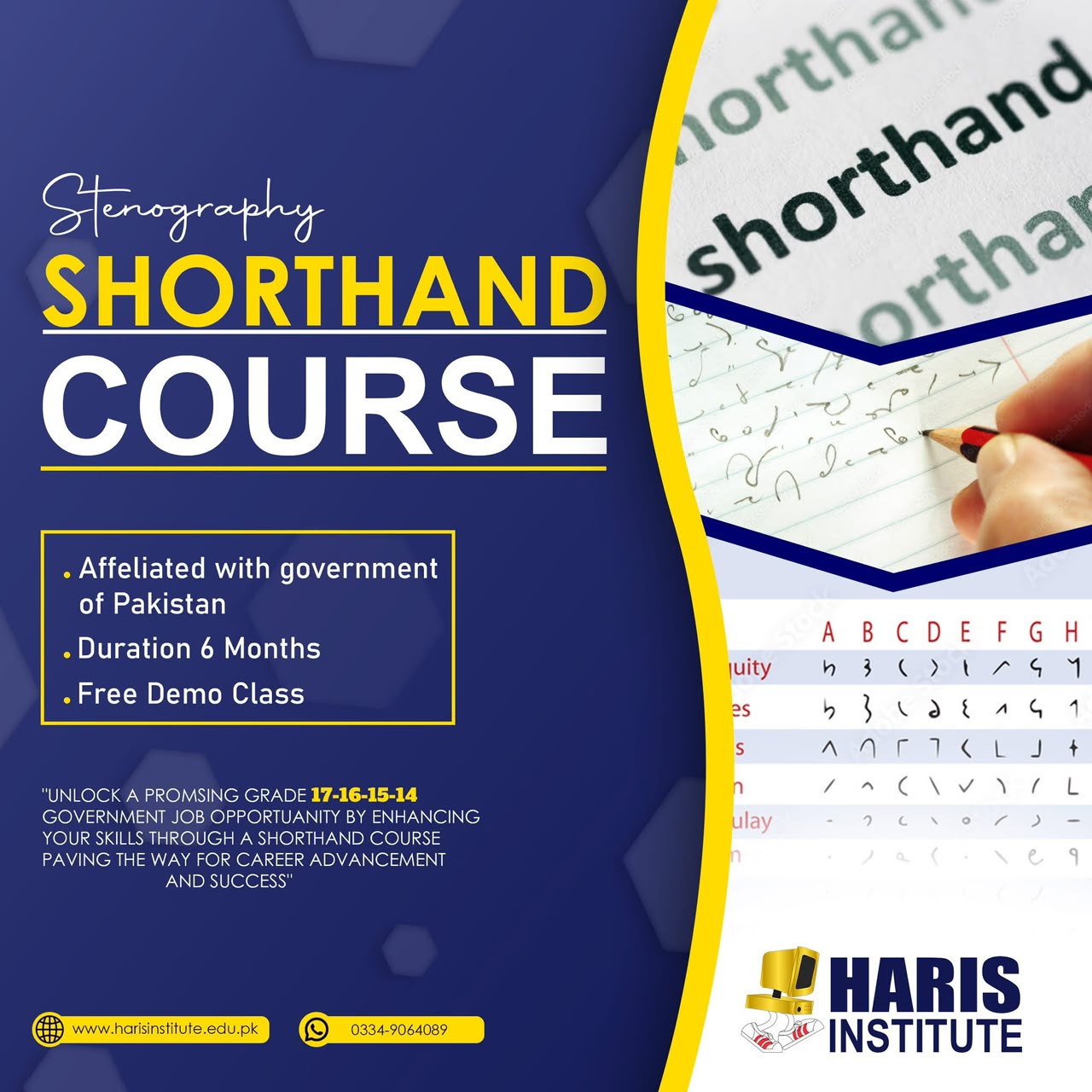
*Haris Institute Rawalpindi* offers a professional *Shorthand Course* designed to help students develop fast writing, accurate note-taking and transcription skills through structured practice.

### 📚 Course Highlights:

* Introduction to Shorthand
* Basic Strokes & Symbols
* Shorthand Writing Techniques
* Dictation Practice
* Speed Building Exercises
* Fast & Accurate Note-Taking
* Transcription of Spoken Material
* Proofreading & Editing
* Practical Assignments

### 🎯 What You Can Develop:

By completing the course, students can improve their *writing speed, accuracy, listening ability, transcription skills and professional communication*.

The course is suitable for students, job seekers and individuals interested in *office administration, secretarial work, legal documentation, journalism and other communication-based roles*.

### 💼 Possible Career Areas:

* Administrative Assistant
* Executive Assistant
* Legal/Office Assistant
* Secretary
* Transcriptionist
* Court & Office Documentation
* Journalism & Reporting

📍 *Haris Institute – Rawalpindi*
Near Midway Plaza, Civil College, 6th Road, Rawalpindi

📞 *Contact:* 0334-0950505

*Admissions Open – Develop a Professional Skill with Practical Training.*

Read More

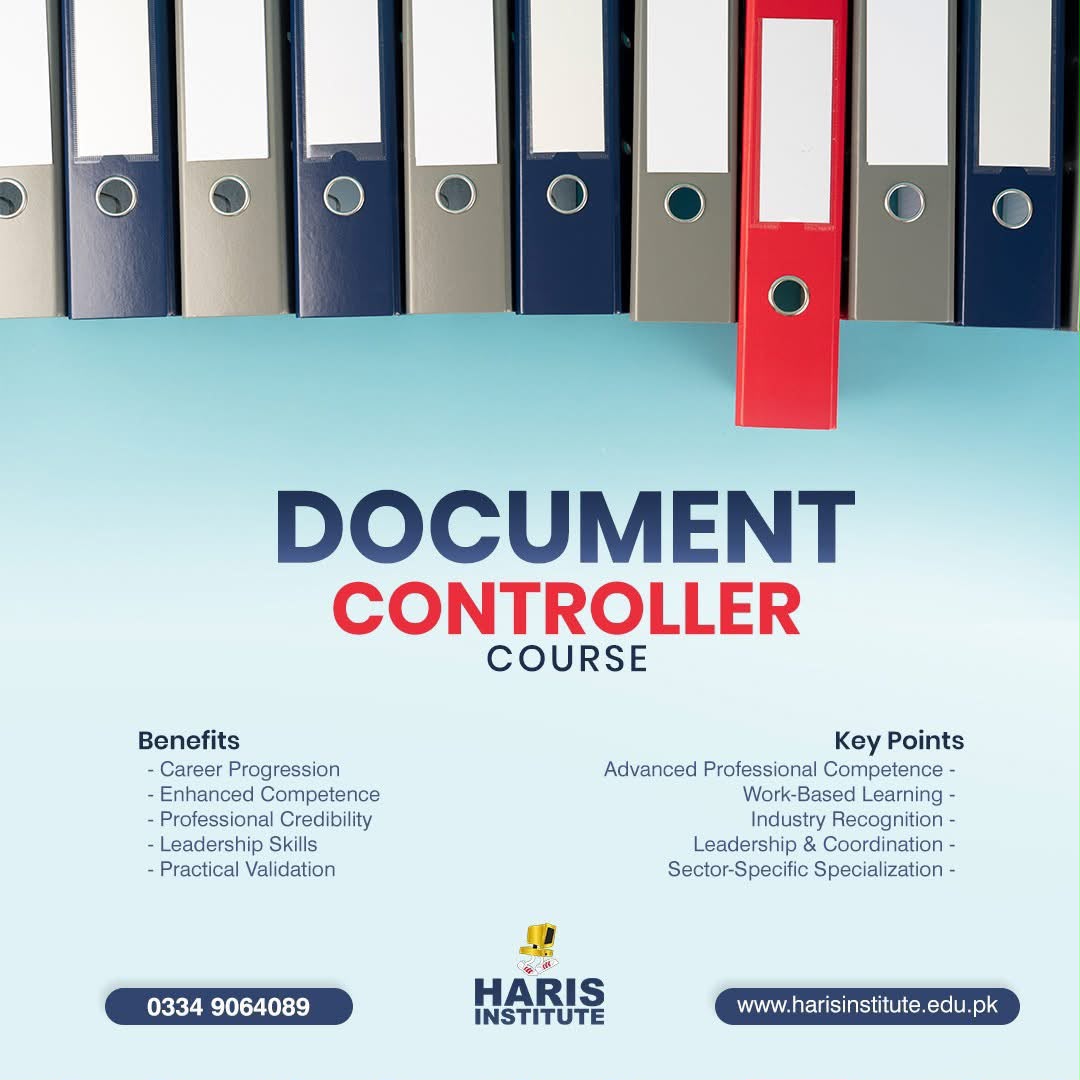
Document Controller Course in Rawalpindi 6th Road

In today’s professional environment, organizations handle thousands of documents, drawings, reports, records and project files. *Effective document control is essential for keeping information organized, accurate, secure and easily accessible.*

*Haris Institute Rawalpindi* offers a career-focused *Diploma in Document Controller* designed to develop the practical knowledge and skills required for document control roles in construction, engineering, corporate and other professional industries.

0334-0950505

document controller course in rawalpindi

### 📚 Course Includes:

* Introduction to Document Control
* Document Management Systems
* Records Management
* Document Control Software
* Document Numbering & Revision Control
* Document Filing & Tracking
* Quality Assurance & Compliance
* Communication & Coordination
* Project Documentation
* Risk Management
* Practical Case Studies

### 🎯 What You Will Learn:

By completing this course, students can develop skills to:

✅ Manage and organize project documents
✅ Maintain document registers and records
✅ Track document revisions and approvals
✅ Coordinate documents with different departments
✅ Apply document control procedures
✅ Support quality and compliance requirements
✅ Handle documentation in real-world projects

### 👨‍💼 Career Opportunities:

After completing the course, you can explore roles such as:

* Document Controller
* Document Control Assistant
* Records Coordinator
* Project Coordinator
* Information Management Assistant
* Document Control Supervisor
* QA/QC Documentation Assistant

This course can be particularly useful for individuals interested in *construction, engineering, project management, QA/QC and corporate documentation*.

📍 *Haris Institute – Rawalpindi*
Near Midway Plaza, Civil College, 6th Road, Rawalpindi

📞 *Contact:* 0334-0950505

*Admissions Open – Start Your Professional Career in Document Control.*

Read More

Data Science Course in Rawalpindi

A Data Science Course in Rawalpindi is designed for students, graduates, professionals, and beginners who want to learn how data can be collected, organized, analyzed, and used for practical decision-making. The course introduces learners to important areas such as Python, data analysis, statistics, databases, data visualization, machine learning, and basic artificial intelligence. Students can learn through practical exercises and real-world examples to develop a better understanding of how data is used in modern businesses and organizations.

+92 334 0950505

This course also focuses on building practical skills that can be useful for data analyst, junior data scientist, business analyst, and data-related roles. Learners can practice working with datasets, creating charts and reports, identifying patterns, and applying basic machine-learning techniques. The Data Science Course in Rawalpindi can provide a structured learning path for those who want to develop their technical skills and explore career opportunities in the growing field of data and technology.

*Why Data Science?*
Aaj har business sales, customers, websites, social media aur operations se huge amounts of data generate karta hai. Lekin raw data tabhi valuable banta hai jab us se meaningful insights aur better decisions nikale ja saken.

*Haris Institute Rawalpindi* mein Data Science course ke through aap data ko understand, analyze aur present karna seekhte hain — with a practical, career-focused approach.

💡 *What You Can Learn:*
* Data Analysis & Data Cleaning
* Python for Data Science
* Statistics & Data Visualization
* Databases & SQL
* Exploratory Data Analysis
* Machine Learning Fundamentals
* Interactive Dashboards & Reports
* Real-World Data Projects

🎯 *Who Can Join?*
Beginners, students, graduates aur professionals jo Data Science aur Analytics mein apni skills develop karna chahte hain. Aapko advanced technical background hone ki zaroorat nahi — curiosity aur learning mindset se start kiya ja sakta hai.

🚀 *By the End of the Course:*
You can work with large datasets, identify patterns, create meaningful visualizations, develop data-driven insights and present your findings in a professional way.

📍 *Haris Institute – Rawalpindi*
Near Midway Plaza, Civil College, 6th Road, Rawalpindi

📞 *Contact:* 0334-0950505

*Admissions Open – Start Learning Data Science Today!*

Read More

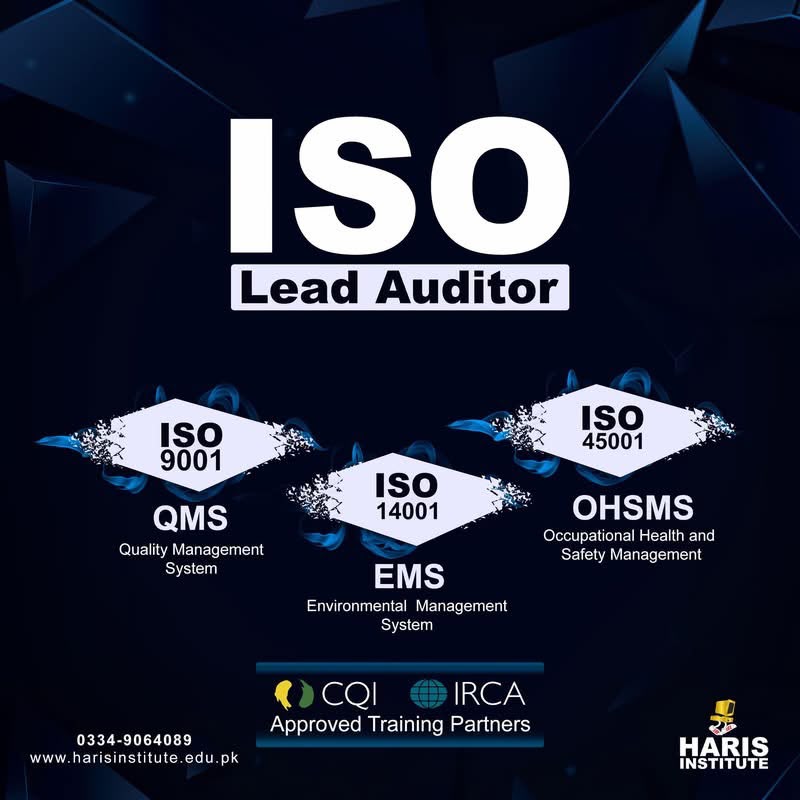
Best ISO Course in Rawalpindi – 6th

PROFESSIONAL ISO STANDARDS & AUDITOR TRAINING

+92 334 0950505

CQI & IRCA CERTIFIED TRAINING

Internationally Recognized Certificate of Achievement

Build professional expertise in internationally recognized ISO Management System Standards through practical, industry-focused training.

iso course in rawalpindi

ISO STANDARDS COVERED

ISO 9001 – Quality Management System (QMS)
Learn how organizations establish and maintain effective quality management systems, improve processes, increase customer satisfaction, control non-conformities, and achieve continual improvement.

ISO 14001 – Environmental Management System (EMS)
Understand environmental aspects and impacts, waste management, pollution prevention, legal compliance, resource efficiency, and sustainable environmental practices.

ISO 45001 – Occupational Health & Safety Management System (OH&S)
Learn workplace hazard identification, risk assessment, operational controls, incident prevention, emergency preparedness, and occupational health & safety management.

ISO 22000 – Food Safety Management System (FSMS)
Develop knowledge of food safety management, HACCP principles, food-chain controls, food safety hazards, prerequisite programs, and regulatory requirements.

ISO/IEC 27001 – Information Security Management System (ISMS)
Learn how organizations protect information through risk assessment, information-security controls, confidentiality, integrity, availability, and continual improvement.

ISO 50001 – Energy Management System (EnMS)
Understand energy performance, energy planning, energy efficiency, monitoring, measurement, and continual improvement of energy management systems.

ISO 13485 – Medical Devices Quality Management System
Learn the quality-management requirements applicable to organizations involved in the design, production, installation, and servicing of medical devices.

ISO/IEC 20000-1 – IT Service Management System (ITSMS)
Understand structured IT service management, service delivery, service performance, customer requirements, and continual improvement.

ISO 22301 – Business Continuity Management System (BCMS)
Learn how organizations prepare for disruptions, manage business continuity risks, respond to incidents, and maintain critical operations.

ISO 37001 – Anti-Bribery Management System (ABMS)
Understand systems and controls designed to prevent, detect, and address bribery risks within organizations.

ISO 39001 – Road Traffic Safety Management System (RTSMS)
Learn the management-system approach to reducing road-traffic safety risks and improving road safety performance.

ISO 55001 – Asset Management System (AMS)
Understand systematic management of organizational assets, asset performance, risk, lifecycle planning, and value optimization.

ISO 42001 – Artificial Intelligence Management System (AIMS)
Learn the management-system framework for responsible AI governance, risk management, transparency, and continual improvement.

PROFESSIONAL TRAINING INCLUDES

* ISO Standards & Management Systems
* Risk Assessment & Risk Management
* Documentation & Procedures
* Internal Audit Techniques
* Non-Conformity & Corrective Actions
* Audit Planning & Reporting
* Management System Implementation
* Continual Improvement
* Practical Case Studies & Documentation Exercises
* Auditor / Lead Auditor Concepts

CERTIFICATION

Upon successful completion of the applicable assessment requirements, participants can receive a CQI & IRCA Certified Certificate of Achievement for the relevant certified training course.

Haris Institute
Professional Technical & Management Training
Peshawar • Mardan • Rawalpindi

Build your professional profile with internationally recognized ISO management-system training.

Read More

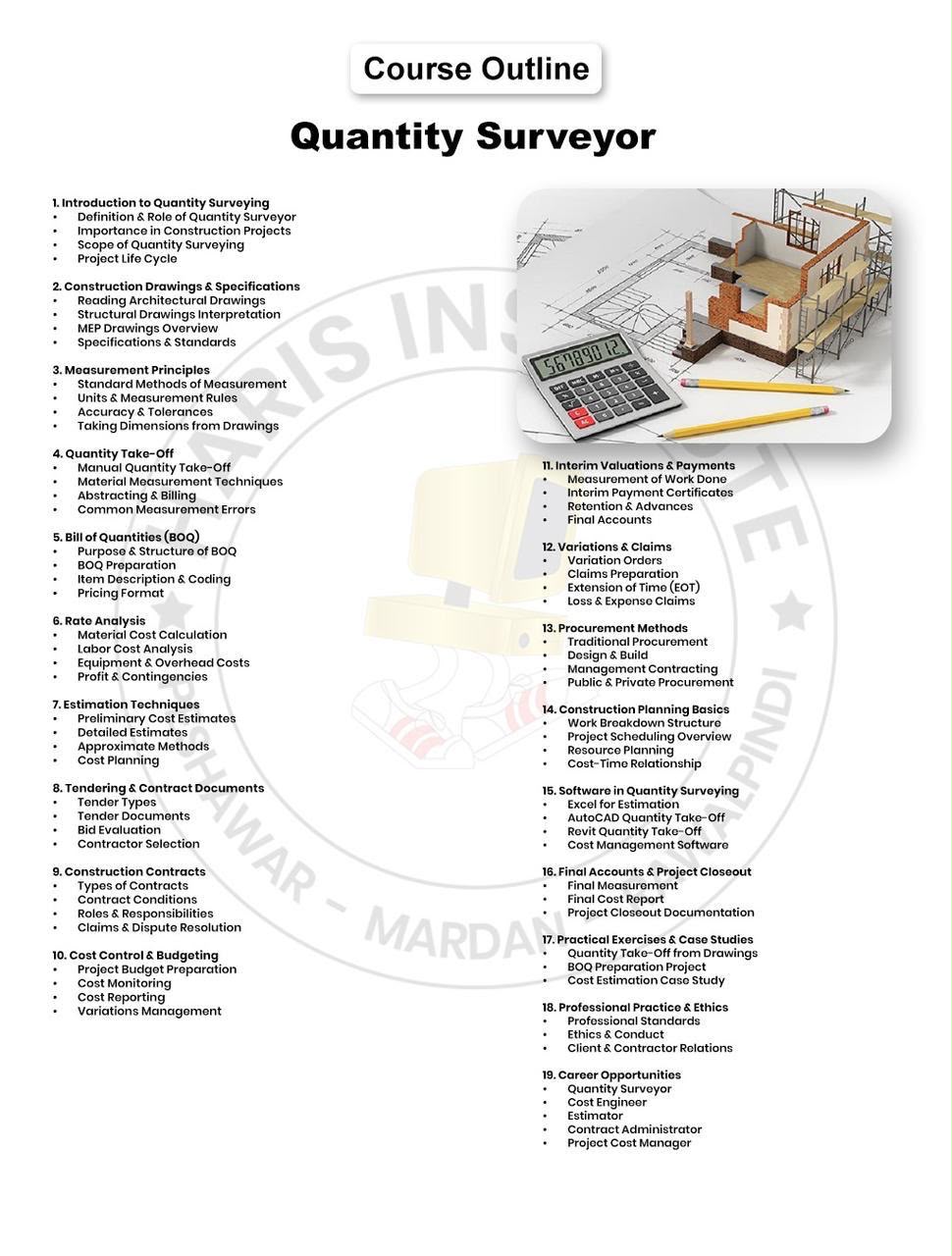
Best Quantity Surveyor Course in Rawalpindi – 6th Road RWP

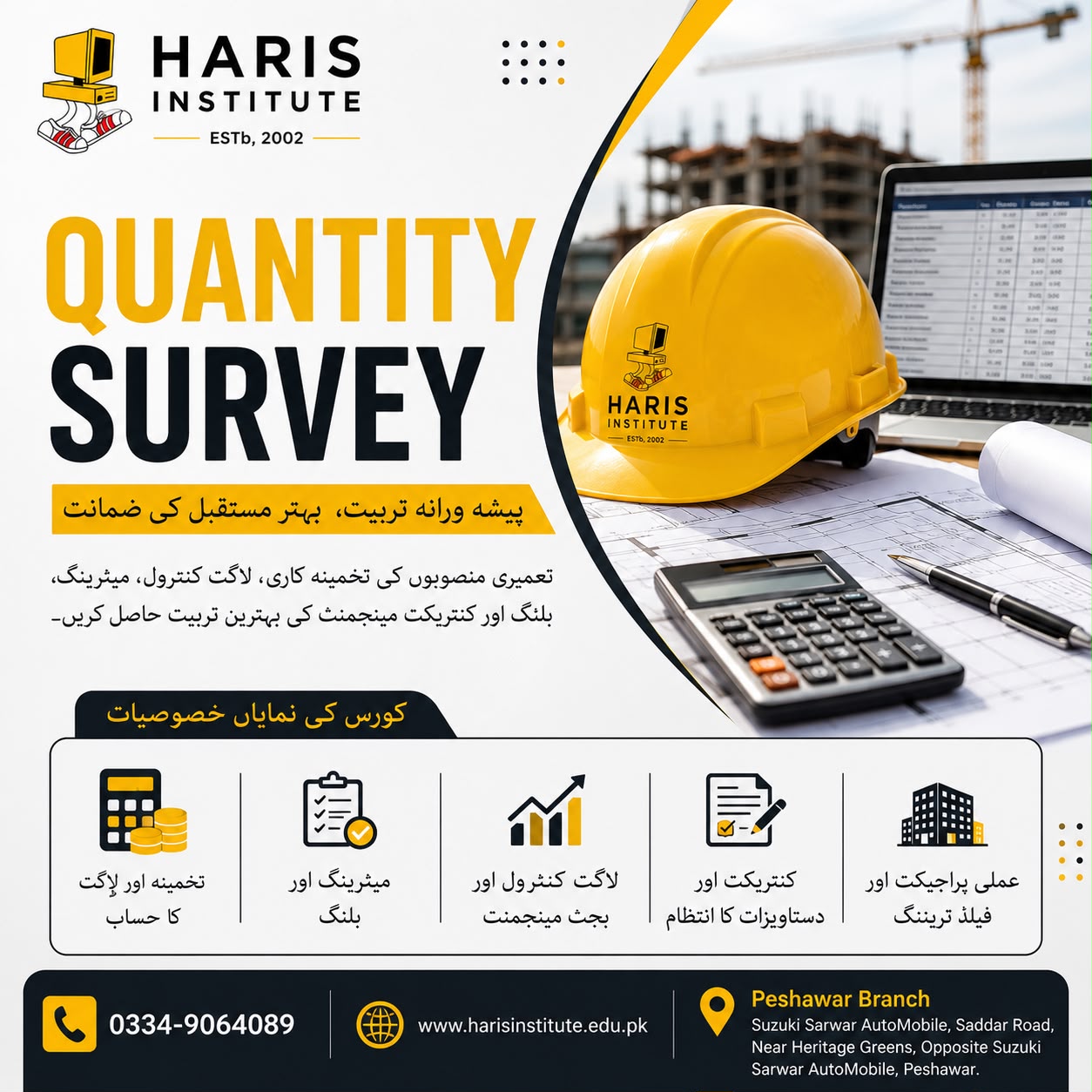
The Quantity Surveyor Course in Rawalpindi is designed for students, beginners, civil engineering learners, and construction professionals who want to develop practical skills in construction measurement and costing. The course introduces learners to important Quantity Surveying tasks such as quantity takeoff, measurement, estimation, rate analysis, BOQ preparation, material calculations, and basic project costing. Students learn how construction quantities are measured from drawings and how this information is organized for project planning.

Quantity Surveyor Course in Rawalpindi

The course also focuses on practical understanding of building drawings, specifications, construction materials, Excel, and estimating techniques used in construction projects. Through simple examples and exercises, learners can improve their ability to prepare measurements, calculate quantities, and organize cost information. This training can provide a useful foundation for those looking to develop careers in quantity surveying, estimation, construction, and site-related work.

Quantity Surveyor Course FAQs

  1. What is a Quantity Surveyor Course?
    It is a course that teaches construction measurement, quantity calculation, estimation, costing, and BOQ preparation.
  2. Who can join a Quantity Surveyor Course in Rawalpindi?
    Students, beginners, civil engineering learners, draftsmen, and construction professionals can join.
  3. Is this course suitable for beginners?
    Yes, the course can start with basic concepts and gradually move toward practical work.
  4. What does a Quantity Surveyor do?
    A Quantity Surveyor measures construction work, prepares quantities, assists with costing, and manages project cost information.
  5. What is quantity takeoff?
    Quantity takeoff is the process of calculating the amount of construction work and materials from drawings and specifications.
  6. What is BOQ?
    BOQ stands for Bill of Quantities. It lists construction items, descriptions, units, quantities, and other pricing information.
  7. What is estimation in construction?
    Estimation is the process of calculating the expected quantities and costs of a construction project.
  8. What is construction costing?
    Construction costing involves calculating the expected cost of materials, labor, equipment, and other project items.
  9. What is rate analysis?
    Rate analysis determines the approximate cost of completing a particular construction item.
  10. Will I learn rate analysis in this course?
    Yes, rate analysis can be covered using practical construction examples.
  11. What are construction measurements?
    Construction measurements determine the size and quantity of work such as concrete, brickwork, plaster, flooring, and excavation.
  12. Will the course teach measurement methods?
    Yes, learners can practice measuring common building works.
  13. What is a measurement sheet?
    It is a worksheet used to record dimensions and calculate quantities of construction work.
  14. What is an abstract of cost?
    It summarizes calculated quantities, rates, and estimated amounts for different construction items.
  15. What is a construction drawing?
    A construction drawing provides technical information about the design, dimensions, and details of a project.
  16. Can I learn how to read building drawings?
    Yes, drawing reading is an important part of quantity surveying.
  17. What types of drawings are useful for Quantity Surveyors?
    Architectural, structural, electrical, plumbing, and other project drawings may be used.
  18. What is a specification?
    A specification describes the required materials, workmanship, standards, and construction requirements.
  19. Why are specifications important?
    They help the Quantity Surveyor understand what type and quality of work should be measured and priced.
  20. Will I learn about construction materials?
    Yes, basic knowledge of materials such as cement, sand, bricks, steel, concrete, and finishing materials can be included.
  21. What is concrete quantity calculation?
    It is the calculation of concrete volume required for elements such as slabs, beams, columns, and foundations.
  22. What is brickwork quantity calculation?
    It involves calculating the volume or area of brick masonry based on project requirements.
  23. What is plaster quantity calculation?
    It determines the plaster area and related material requirements for walls or ceilings.
  24. What is excavation quantity?
    Excavation quantity is the volume of soil that needs to be removed for foundations, trenches, or other works.
  25. Will I learn steel quantity calculation?
    Basic reinforcement measurement and quantity calculation can be included depending on the course syllabus.
  26. What is wastage in construction?
    Wastage refers to material lost or consumed beyond the calculated requirement during construction.
  27. Why is material calculation important?
    Accurate material calculation helps with purchasing, planning, and controlling construction costs.
  28. Is MS Excel used in Quantity Surveying?
    Yes, Excel is commonly useful for calculations, measurement sheets, BOQs, and cost summaries.
  29. Will I learn Excel for Quantity Surveying?
    A practical course can include Excel worksheets for construction estimation and costing.
  30. Can beginners learn construction estimation in Excel?
    Yes, basic Excel formulas and structured worksheets can be taught step by step.
  31. What is a rate in a BOQ?
    A rate represents the cost assigned to a particular unit of construction work.
  32. What is the difference between quantity and rate?
    Quantity shows how much work is required, while rate represents the cost per unit of that work.
  33. How is an estimated amount calculated?
    A basic calculation is Quantity × Rate = Amount.
  34. What is unit measurement?
    It is the standard unit used to measure a construction item, such as m³, m², m, kg, or number.
  35. What is a construction work item?
    It is an individual activity or component included in a construction project, such as excavation, concrete, or plaster.
  36. Can I practice house estimation?
    Yes, residential building examples can be used for practical estimation exercises.
  37. Will I learn foundation estimation?
    Basic foundation measurement and quantity calculation can be covered through practical examples.
  38. Will I learn slab estimation?
    Yes, slab dimensions and basic quantity calculations can be practiced.
  39. Will I learn wall measurement?
    Yes, wall dimensions can be used to calculate brickwork and plaster quantities.
  40. What is project cost control?
    Cost control involves monitoring project expenses and comparing them with planned costs.
  41. What is tendering?
    Tendering is a process through which contractors submit offers to carry out construction work.
  42. What is a contractor’s estimate?
    It is an estimate prepared to understand the expected cost of completing construction work.
  43. Can a Quantity Surveyor work with contractors?
    Yes, Quantity Surveyors can work with contractors, consultants, developers, and construction companies.
  44. Can I work on residential projects after the course?
    The course can provide foundational skills for residential estimation and quantity-related work.
  45. What jobs are related to Quantity Surveying?
    Possible entry-level roles include Quantity Surveyor Assistant, Junior Quantity Surveyor, Estimation Assistant, Costing Assistant, and Measurement Assistant.
  46. Can the course help with construction jobs?
    It can help develop practical estimating and measurement skills that are relevant to construction-related positions.
  47. Is practical training important for Quantity Surveying?
    Yes, practical exercises help learners understand how theoretical measurements are applied to actual projects.
  48. How long does a Quantity Surveyor Course take?
    Duration varies by institute and syllabus; short-term and detailed training programs may have different schedules.
  49. Can I learn Quantity Surveying without a civil engineering degree?
    Beginners can learn the fundamentals, although advanced professional roles may have specific education or experience requirements.
  50. What will I be able to do after completing the course?
Read More

Top 10 Colleges in 6th Road Rawalpindi

Finding the right college is an important decision for students and parents, especially when several educational institutions are located around the same area. 6th Road, Satellite Town, Rawalpindi is one of the well-known education hubs of the city, with colleges and educational institutes offering programs in science, commerce, computer studies, law, and other fields.

Students looking for a college near 6th Road can find both private and government-sector options. The right choice depends on the student’s academic group, desired program, budget, location, class schedule, and future education plans.

Below is a practical list of 10 colleges and educational institutions around 6th Road Rawalpindi that students may consider.

1. Punjab College – 6th Road

Punjab College has a campus on D-464, 6th Road, Satellite Town, Rawalpindi. It is a well-known private college network offering intermediate-level education and other academic programs.

Students interested in science, computer studies, commerce, and related intermediate subjects may consider this campus. Its location on 6th Road also makes it convenient for students living in Satellite Town and nearby areas.

2. Punjab Group of Colleges – D-9 Campus

The Punjab Group of Colleges D-9 Campus is located on 6th Road, Satellite Town, Rawalpindi. The campus provides another option for students searching for intermediate education in the area.

The college is particularly relevant for students comparing private-sector colleges on 6th Road and looking for a structured academic environment.

3. KIPS College – 6th Road Campus

KIPS College has a campus at D-5A, 6th Road, Satellite Town, Rawalpindi.

KIPS is known for its college-level academic programs and preparation-oriented educational environment. Students can consider this campus when comparing options for intermediate studies and academic preparation.

4. STEPS College for Girls

STEPS College for Girls is located at 777, 6th Road, Satellite Town, Rawalpindi.

It provides an option specifically for female students who want to study in the 6th Road area. Students and parents can check the current admission programs, subject groups, fee structure, and eligibility requirements before applying.

5. Rawalpindi College of Commerce

Rawalpindi College of Commerce is located at 31-D, 6th Road, Satellite Town, Rawalpindi.

As its name suggests, the institution is particularly relevant for students interested in commerce and business-related education. Students considering accounting, commerce, business, or related subjects can include it in their college comparison.

6. Jinnah Institute of Informatics and Commerce

Jinnah Institute of Informatics and Commerce is another educational institution located on 6th Road in Satellite Town. Punjab’s Higher Education Department lists the institute at 470-D, 6th Road, Satellite Town, Rawalpindi.

The institute can be considered by students interested in computer-related and commerce education. Before admission, students should confirm the current programs and affiliation details directly with the college.

7. Civil College

Civil College is situated on 6th Road, Satellite Town, Rawalpindi. The Punjab Higher Education Department lists Civil College of Commerce at 783-F, Satellite Town, Siddiqi Chowk, 6th Road.

It may be suitable for students looking for commerce-focused education close to the main 6th Road educational area.

8. The Leaders College

The Leaders College is located at 30-D, 6th Road, Satellite Town, Rawalpindi. It appears in the Punjab Higher Education Department’s directory of private intermediate colleges in Rawalpindi.

Students looking for a private college around 6th Road can compare its current courses, admission requirements, fee structure, and academic schedule with other nearby institutions.

9. Indus College of Commerce

Indus College of Commerce for Boys is listed at 89-A, 6th Road, Satellite Town, Rawalpindi, in the Punjab Higher Education Department’s private intermediate-college directory.

It can be an option for students interested in commerce education. Students should contact the institution to verify currently available programs and admissions.

10. Zawiya College

Zawiya College is another college option in the 6th Road/Satellite Town area. The Punjab Higher Education Department lists Zawiya College for Boys near the 6th Road bus stop on Murree Road and also lists a girls’ campus nearby.

Its location can be convenient for students living around Satellite Town, Murree Road, and nearby neighborhoods.

How to Choose a College on 6th Road Rawalpindi

Choosing a college should not be based only on the name of the institution. Students should consider several practical factors before submitting an admission form.

1. Choose the Right Subject Group

First decide whether you want to study:

  • Pre-Medical
  • Pre-Engineering
  • ICS
  • Commerce
  • Arts/Humanities
  • Computer-related subjects
  • Other professional programs

Not every college offers the same combination of subjects.

2. Check the Fee Structure

Private colleges can have different tuition fees, admission charges, examination charges, and other expenses. Ask for a complete fee schedule before admission.

3. Check Affiliation

Students should verify the relevant board or university affiliation and make sure the program they are applying for is currently recognized.

4. Consider Distance and Transport

6th Road is a busy part of Rawalpindi. A college close to home can reduce daily transportation time and expenses.

5. Ask About Scholarships

Some institutions offer scholarships, fee concessions, or merit-based opportunities. Students should ask about the current scholarship policy before enrollment.

6. Compare Class Timings

Class schedules can vary between colleges. This is particularly important for students who use public transport or have other study commitments.

Why 6th Road Is Popular for Students

6th Road and Satellite Town have a large concentration of educational institutions. Students can find multiple colleges within a relatively short distance, making it easier to compare different academic options.

The area is also connected with major parts of Rawalpindi through roads and public transportation routes. This makes it a practical location for students coming from Satellite Town, Commercial Market, Chandni Chowk, Murree Road, and surrounding neighborhoods.

Final Thoughts

There are several colleges and educational institutions around 6th Road, Satellite Town, Rawalpindi, giving students a variety of choices. Punjab College, KIPS College, STEPS College for Girls, Rawalpindi College of Commerce, Jinnah Institute of Informatics and Commerce, Civil College, The Leaders College, Indus College of Commerce, and Zawiya College are among the institutions students can investigate.

However, the best college for a particular student depends on the program, budget, admission requirements, academic goals, and transportation needs. Before making a final decision, students should visit the campus, confirm the current admission schedule, ask for the latest fee structure, and verify affiliation and available subjects.

Frequently Asked Questions

Which area has many colleges in Rawalpindi?

6th Road and Satellite Town are among the areas of Rawalpindi where students can find a number of colleges and educational institutions.

Which colleges are located on 6th Road Rawalpindi?

Several institutions are located on or close to 6th Road, including Punjab College, KIPS College, Rawalpindi College of Commerce, Jinnah Institute of Informatics and Commerce, Civil College, and other private colleges.

Is 6th Road suitable for college students?

Yes. The area has a concentration of educational institutions and is accessible from several parts of Rawalpindi.

Which subjects can students study at colleges around 6th Road?

Available subjects vary by institution. Common options can include pre-medical, pre-engineering, ICS, commerce, computer studies, and humanities.

Should I compare colleges before admission?

Yes. Students should compare programs, fees, affiliation, faculty, class timings, location, transport, and admission requirements before selecting an institution.

6th Road in Satellite Town, Rawalpindi, is a popular educational area where students can find several colleges and academic institutions offering different study options. Students searching for colleges in 6th Road Rawalpindi can explore institutions such as Punjab College, KIPS College, STEPS College for Girls, Rawalpindi College of Commerce, Civil College, and other nearby institutes. The area is convenient for students from Satellite Town, Commercial Market, Murree Road, Chandni Chowk, and surrounding localities. Depending on their academic goals, students may find options related to intermediate studies, commerce, computer education, and other subjects.

Before choosing a college on 6th Road, students should compare important factors such as available subjects, admission requirements, fee structure, class timings, campus environment, transportation, and relevant board or university affiliation. Visiting the college and discussing the program details with the administration can also help students make an informed decision. Whether a student is looking for a college near 6th Road Rawalpindi, an intermediate college, a commerce institute, or a girls’ college, comparing several local options can make the admission process easier and more suitable for their educational plans.

Read More

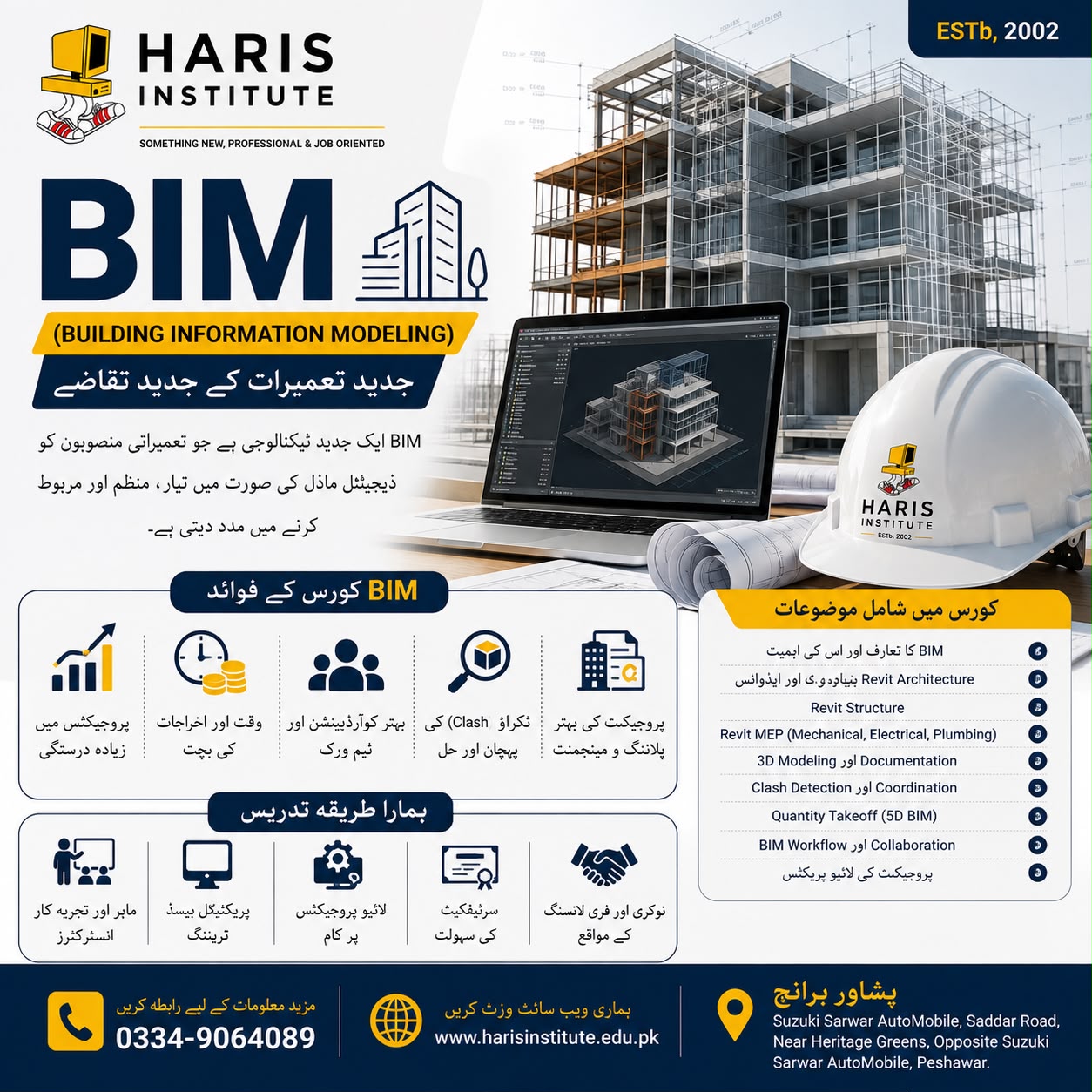
Bim Course in Peshawar

Become a professional BIM Engineer with practical training at Haris Institute. BIM training programs can assist you in mastering 3D modeling, project visualization, and collaborative design methods. You can develop expertise in construction documentation, clash detection, and lifecycle management. Numerous courses present software such as Revit, Navisworks, and AutoCAD, demonstrating how these tools optimize workflows and improve communication among participants in architecture, engineering, and construction initiatives.Haris institute using industry-leading software such as Autodesk Revit, Navisworks, AutoCAD, and BIM workflows. This course prepares students to create intelligent 3D building models, coordinate multidisciplinary projects, detect design clashes, and manage construction data for local and international projects.

Why Learn BIM?

Building Information Modeling (BIM) has become the global standard for designing, constructing, and managing buildings. BIM professionals are highly demanded in construction companies, engineering consultancies, architectural firms, and infrastructure projects across Pakistan and the Gulf countries.

BIM professionals are employed in:

* Construction Companies
* Architectural Firms
* Engineering Consultants
* Infrastructure Projects
* Oil & Gas Companies
* MEP Contractors
* Real Estate Developers
* Government Organizations
* Project Management Companies

Course Objectives

This course is designed to develop practical BIM skills based on international construction standards.

Students will learn to:

* Create intelligent 3D building models
* Develop architectural, structural, and MEP models
* Coordinate multidisciplinary projects
* Detect clashes before construction
* Generate drawings, schedules, and quantities
* Apply BIM workflows on real projects

What You Will Learn

Module 1 – Introduction to BIM

* Introduction to BIM
* BIM Concepts & Standards
* BIM Levels
* BIM Workflow
* Project Setup

Module 2 – Autodesk Revit

* User Interface
* Project Templates
* Levels & Grids
* Walls, Doors & Windows
* Floors & Roofs
* Stairs & Railings
* Families & Components

Module 3 – Structural BIM

* Columns
* Beams
* Foundations
* Slabs
* Reinforcement Basics
* Structural Documentation

Module 4 – MEP BIM

* HVAC Systems
* Plumbing Systems
* Electrical Systems
* Cable Trays
* Pipe Routing
* Equipment Placement

Module 5 – BIM Coordination

* Model Linking
* Worksharing
* Clash Detection
* Coordination Review
* BIM Collaboration

Module 6 – Navisworks

* Model Integration
* Clash Detection
* 4D Construction Simulation
* Model Review
* Coordination Reports

Module 7 – Documentation & Quantity Takeoff

* Sheets & Views
* Schedules
* Material Quantities
* BOQ Generation
* Printing & Export

Module 8 – Practical Projects

* Residential Building Model
* Commercial Building Project
* Structural Coordination
* MEP Coordination
* Clash Detection Project
* Final BIM Project

Software Covered

* Autodesk Revit
* Autodesk Navisworks
* AutoCAD
* BIM 360 (Introduction)

Practical Training

Students receive hands-on training in:

* 3D Building Modeling
* Architectural Modeling
* Structural Modeling
* MEP Modeling
* Clash Detection
* Construction Documentation
* Quantity Takeoff
* BIM Coordination

Skills You Will Gain

* BIM Modeling
* Revit Architecture
* Revit Structure
* Revit MEP
* Clash Detection
* BIM Coordination
* Construction Documentation
* Quantity Takeoff
* Project Collaboration
* 3D Design

Career Opportunities

After completing the course, you can work as:

* BIM Modeler
* BIM Engineer
* BIM Coordinator
* Revit Modeler
* Architectural BIM Modeler
* Structural BIM Modeler
* MEP BIM Modeler
* BIM Technician
* Design Engineer
* CAD/BIM Specialist

Who Should Join?

* Matric Students
* Intermediate Students
* DAE Civil Students
* Civil Engineers
* Architects
* Structural Engineers
* Mechanical Engineers
* Electrical Engineers
* MEP Engineers
* Working Professionals

Why Choose Haris Institute?

* Practical Project-Based Training
* Experienced Industry Trainers
* Latest BIM Software
* Real Construction Projects
* Professional Certificate
* Interview Preparation
* Career Guidance
* Job Assistance

Bim Course in Peshawar

Read More

Quantity Surveyor Course in Peshawar

Professional Quantity Surveyor with practical training at Haris Institute. Learn construction cost estimation, quantity takeoff, BOQ preparation, tendering, billing, contracts, and project cost control using industry-standard methods at haris institute. Quantity Survey training prepares students for careers in construction companies, consulting firms, contractors, and infrastructure projects across Pakistan and the Gulf countries.

Why Learn Quantity Surveying?

Quantity Surveying is one of the most valuable professions in the construction industry. Quantity Surveyors help manage project costs, prepare estimates, control budgets, and ensure construction projects are completed within financial targets.

Professional Quantity Surveyors are employed in:

* Construction Companies
* Engineering Consultants
* Government Departments
* Real Estate Developers
* Infrastructure Projects
* Oil & Gas Companies
* Contractors
* Project Management Firms

Course Objectives

This course is designed to develop practical quantity surveying skills required by the construction industry.

Students will learn to:

* Calculate construction quantities
* Prepare BOQs (Bill of Quantities)
* Estimate project costs
* Prepare tender documents
* Manage project billing
* Control project costs
* Understand construction contracts

What You Will Learn

Module 1 – Introduction to Quantity Surveying

* Role of a Quantity Surveyor
* Construction Terminology
* Project Documentation
* Drawing Interpretation

Module 2 – Quantity Takeoff

* Earthwork Quantities
* Concrete Quantities
* Reinforcement Calculation
* Masonry Works
* Plaster Works
* Flooring
* Roofing
* Finishing Works

Module 3 – BOQ Preparation

* Bill of Quantities (BOQ)
* Measurement Rules
* BOQ Formatting
* Item Descriptions

Module 4 – Cost Estimation

* Material Cost Estimation
* Labour Cost Estimation
* Equipment Cost
* Project Budgeting
* Rate Analysis

Module 5 – Tendering & Contracts

* Tender Documents
* Bidding Process
* Contract Types
* FIDIC Basics
* Procurement Process

Module 6 – Billing & Payment

* Running Bills
* IPC Preparation
* Payment Certificates
* Variation Orders
* Final Account Preparation

Module 7 – Software Training

* Microsoft Excel
* AutoCAD Drawing Reading
* BOQ Preparation
* Quantity Calculation Sheets

Module 8 – Practical Projects

* Residential Building Estimation
* Commercial Building BOQ
* Quantity Takeoff Practice
* Cost Estimation Project
* Tender Documentation

Practical Training

Students receive hands-on training in:

* Quantity Takeoff
* BOQ Preparation
* Cost Estimation
* Tender Documents
* Billing
* Drawing Interpretation
* Construction Documentation

Skills You Will Gain

* Quantity Takeoff
* Cost Estimation
* BOQ Preparation
* Rate Analysis
* Tender Preparation
* Billing & IPC
* Cost Control
* Construction Documentation
* Excel for Quantity Surveying
* Drawing Reading

Career Opportunities

After completing the course, you can work as:

* Quantity Surveyor
* Junior Quantity Surveyor
* Estimation Engineer
* Cost Engineer
* Billing Engineer
* Tender Engineer
* Contracts Assistant
* Project Cost Controller

Who Should Join?

* Matric Students
* Intermediate Students
* DAE Civil Students
* Civil Engineers
* Site Engineers
* Construction Supervisors
* Fresh Graduates
* Working Professionals

Why Choose Haris Institute?

* Practical Project-Based Training
* Experienced Industry Trainers
* Real Construction Drawings
* Modern Computer Lab
* Professional Certificate
* Interview Preparation
* Career Guidance
* Job Assistance

Quantity Surveyor Course in Peshawar

Read More

Rigger Course in Peshawar

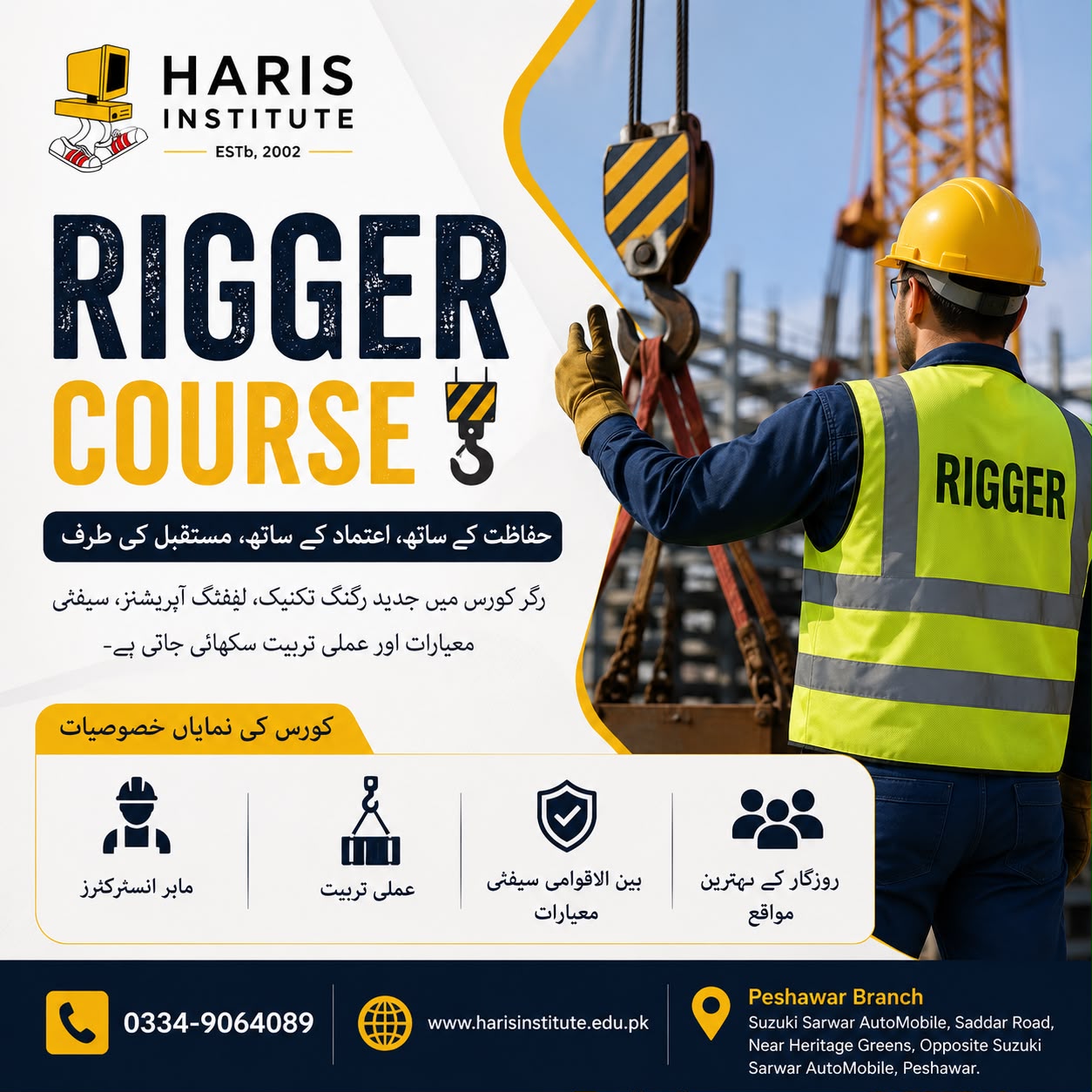
ecome a professional Rigger Course with practical training at institute based on international lifting and safety standards. At Haris Institute, students learn safe lifting practically operations, rigging equipment inspection, crane communication, load calculations, and industry-approved lifting procedures. Haris institute prepares you for jobs in construction, oil & gas, petrochemical plants, shipyards, power plants, and industrial projects across Pakistan and the Gulf countries

Why Learn Rigging?

Rigging is one of the most in-demand technical skills in heavy industries. Every major construction and industrial project requires trained riggers to ensure lifting operations are completed safely and efficiently.

Professional riggers are employed in:

* Construction Companies
* Oil & Gas Projects
* Petrochemical Plants
* Power Plants
* Shipyards
* Manufacturing Industries
* Heavy Engineering Projects
* Infrastructure Projects

Course Objectives

This course is designed to provide practical knowledge and hands-on experience in lifting operations.

Students will learn to:

* Inspect lifting equipment
* Select the correct lifting gear
* Calculate safe working loads
* Perform safe lifting operations
* Communicate with crane operators
* Follow international safety procedures

What You Will Learn

Module 1 – Introduction to Rigging

* Introduction to Rigging
* Roles & Responsibilities
* Safety Rules
* PPE Requirements

Module 2 – Rigging Equipment

* Wire Rope Slings
* Chain Slings
* Web Slings
* Shackles
* Hooks
* Eye Bolts
* Turnbuckles
* Lifting Beams

Module 3 – Lifting Operations

* Load Assessment
* Center of Gravity
* Sling Angles
* Safe Lifting Methods
* Tag Line Usage
* Load Securing

Module 4 – Crane Operations

* Types of Cranes
* Mobile Crane
* Tower Crane
* Overhead Crane
* Crane Safety
* Communication with Crane Operator

Module 5 – Inspection & Maintenance

* Equipment Inspection
* Defective Gear Identification
* Storage Procedures
* Maintenance
* Color Coding

Module 6 – Lift Planning

* Lift Plan
* Risk Assessment
* Method Statement
* Permit to Work
* Toolbox Talk

Module 7 – Hand Signals

* Standard Crane Hand Signals
* Radio Communication
* Emergency Signals

Module 8 – Practical Training

* Slinging Practice
* Rigging Equipment Inspection
* Load Lifting
* Safe Load Movement
* Real Site Demonstration

Practical Training

Students receive hands-on training using:

* Wire Rope Slings
* Chain Slings
* Shackles
* Hooks
* Chain Blocks
* Hoists
* Lifting Accessories
* Safety Equipment

Skills You Will Gain

* Safe Rigging Techniques
* Load Calculation
* Lifting Gear Inspection
* Crane Communication
* Hand Signal Knowledge
* Risk Assessment
* Workplace Safety
* Team Coordination

Career Opportunities

After completing the course, you can work as:

* Rigger
* Rigger Level I
* Rigger Level II
* Rigger Level III
* Senior Rigger
* Rigging Foreman
* Lifting Supervisor
* Lifting Coordinator

Who Should Join?

* Matric Students
* Intermediate Students
* DAE Students
* Fresh Job Seekers
* Construction Workers
* Technicians
* Industrial Workers

Why Choose Haris Institute?

* Practical Hands-on Training
* Experienced Trainers
* Industry-Based Curriculum
* Professional Certificate
* Interview Preparation
* Career Guidance
* Job Assistance

Rigger Course in Peshawar

Read More

Auto Electrician Course in Peshawar | Haris Institute

Auto Electrician Course in Peshawar | Haris Institute Looking for a professional Auto Electrician Course in Peshawar? Haris Institute offers practical training designed for students who want to build a career in the automobile industry. Our training focuses on real workshop experience so students learn by working on actual vehicles. The course is suitable for beginners as well as individuals who want to improve their existing skills.

Auto Electrician Course Outline

* Introduction to Auto Electrical Systems
* Vehicle Battery & Charging System
* Alternator Testing & Repair
* Starter Motor System
* Ignition System
* Wiring Diagrams & Circuit Reading
* Fuse Box & Relay System
* Vehicle Lighting System
* Power Windows & Central Locking
* Car AC Electrical Basics
* ECU (Engine Control Unit) Introduction
* OBD Computer Diagnostics
* Sensor Testing
* Multimeter & Diagnostic Tools
* Electrical Fault Finding
* Hybrid & Modern Vehicle Electrical Basics
* Practical Workshop Training
* Safety Procedures


1. What skills will I learn in an Auto Electrician Course?

An Auto Electrician Course teaches you how to diagnose and repair electrical faults in cars, install wiring systems, test batteries, alternators, starters, lighting circuits, sensors, and use modern vehicle diagnostic tools.

2. Is this course suitable for beginners with no technical background?

Yes. Most Auto Electrician Courses start with basic electrical concepts before moving to practical vehicle repair. Beginners can learn step by step through classroom lessons and hands-on workshop training.

3. What career opportunities are available after completing an Auto Electrician Course?

Graduates can work as auto electricians, vehicle diagnostic technicians, workshop assistants, service center technicians, or start their own automotive electrical repair business. Skilled professionals are in demand in Pakistan and many overseas countries.

4. How long does it take to complete an Auto Electrician Course?

The duration depends on the training institute. Most certificate courses take between 3 to 6 months, while advanced diploma programs may require 6 to 12 months, including practical workshop experience.

5. Why is practical training important in an Auto Electrician Course?

Practical training helps students gain real-world experience by working on actual vehicles. It improves troubleshooting skills, builds confidence in using professional tools, and prepares students for employment in automotive workshops and service centers.

Read More